Home
Blog
Oppora’s Claude MCP is Live. Connect our Email Database & Outreach features with any tool to build smart automations inside Claude.
Home
Blog
Manasa Goli
Published July 11, 2026
8 min
Try Oppora AI
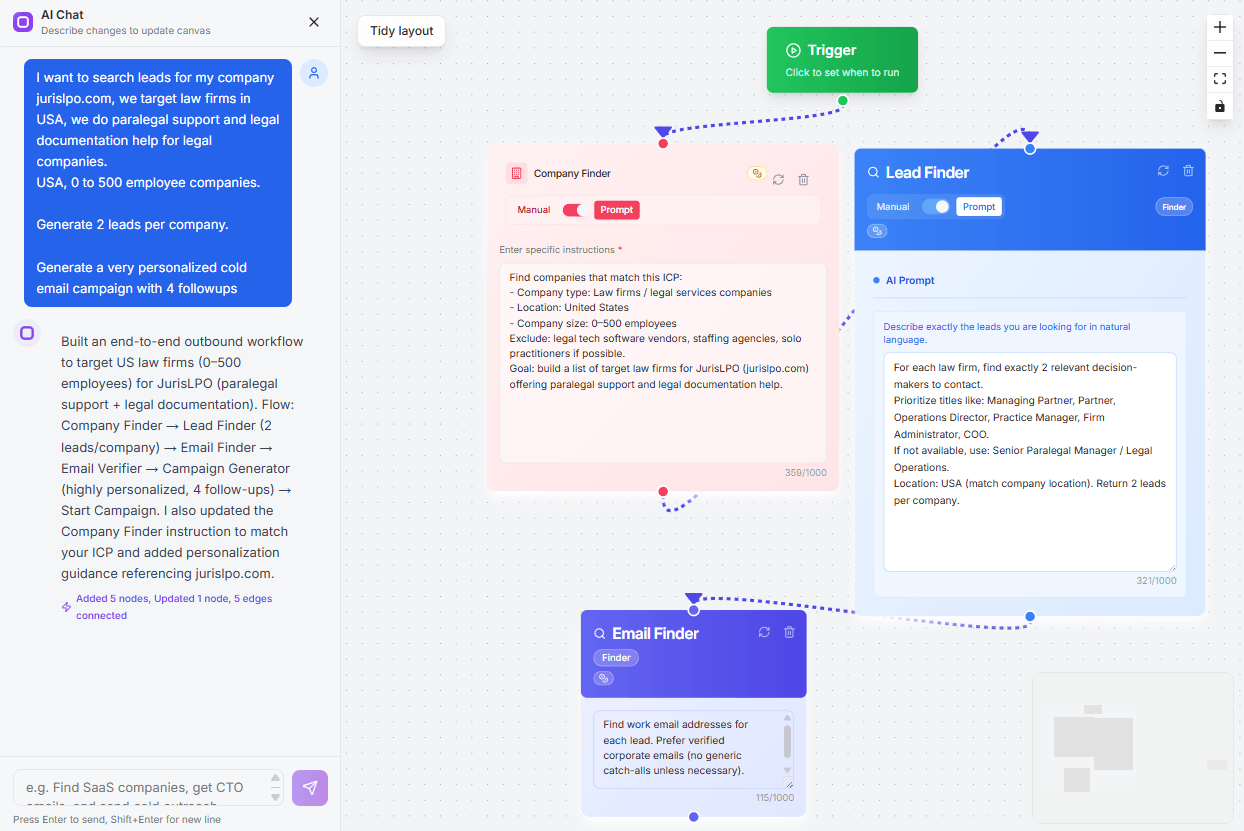
Create Self-Running Agentic Sales Workflows like N8N just by chatting with AI
Get Started for FREE
AI has become part of almost every business conversation today. From writing emails to analyzing reports, it already helps teams complete many routine tasks faster.
But there is one challenge that still slows businesses down.
Most AI tools only do what you explicitly ask them to do. They generate an answer, complete a task, and then stop. The next step still depends on you.
That is where AI agentic workflows change the game.
Instead of waiting for instructions after every action, AI agents can plan, make decisions, adapt to changing situations, and complete a sequence of connected tasks with minimal human intervention. They work more like intelligent teammates than traditional software.
As organizations look for ways to automate increasingly complex processes, agentic workflows are quickly becoming one of the biggest advancements in enterprise AI.
In this guide, you'll learn:
Let's begin by understanding what makes an AI workflow truly agentic.
AI agentic workflows are automated processes powered by AI agents that can plan, make decisions, and complete multiple connected tasks with minimal human intervention.
Unlike traditional automation, which follows fixed rules, AI agents can understand context, adapt to new information, and decide the next best action to achieve a goal.
For example, instead of simply generating an email, an AI agentic workflow can identify a lead, research the company, draft a personalized email, schedule follow-ups, update the CRM, and notify the sales team only when needed.
In simple terms, AI agentic workflows don't just automate individual tasks—they automate the entire decision-making process behind those tasks.
Now that you know what AI agentic workflows are, it's easier to see why they're often described as the next evolution of automation.
While both approaches help reduce manual work, they solve problems in very different ways.
Traditional AI automation is designed to execute predefined tasks. It follows fixed rules, meaning every step must be planned in advance. If something unexpected happens, the workflow usually stops or requires human intervention.
AI agentic workflows, on the other hand, are built to think through situations. AI agents can analyze context, make decisions, adapt to changing inputs, and determine the next best action without needing constant instructions.
Here's a quick comparison:
For example, imagine you're automating customer support.
With traditional automation, a chatbot answers common questions using predefined responses. If a customer asks something outside its programmed flow, the conversation is handed over to a human agent.
An AI agentic workflow takes a different approach.
It understands the customer's issue, searches internal knowledge bases, checks account details, determines the best resolution, performs approved actions, and only escalates the conversation if human expertise is genuinely required.
The same difference applies across sales, marketing, finance, HR, and IT operations.
Traditional automation helps you complete individual tasks faster.
AI agentic workflows help you automate entire business processes by combining reasoning, planning, and execution into a single intelligent workflow.
The true value of AI agentic workflows becomes clear when you see them solving real business problems.
Instead of automating one isolated task, AI agents can coordinate multiple actions, make decisions along the way, and keep processes moving with minimal human involvement.
Here are some of the most practical applications across industries.
Sales teams spend a significant amount of time researching prospects, qualifying leads, writing personalized emails, and following up consistently.
An AI agentic workflow can automate this entire process. It can identify potential leads, enrich their information, score them based on predefined criteria, generate personalized outreach, schedule follow-ups, and update the CRM automatically.
This allows sales representatives to spend more time building relationships with qualified prospects instead of handling repetitive administrative work.
Modern customer support goes beyond answering frequently asked questions.
AI agentic workflows can understand customer queries, retrieve relevant information from internal systems, resolve common issues, create support tickets when needed, and escalate complex cases to human agents with complete conversation history.
The result is faster response times and a more consistent customer experience.
Suggested Reading:
10 Agentic AI Workflow Tools That Automate Work End-to-EndLaunching a successful marketing campaign involves multiple moving parts.
AI agents can research audience segments, generate campaign ideas, create content variations, schedule posts across channels, monitor campaign performance, and recommend optimizations based on real-time data.
Instead of managing every task manually, marketers can focus on strategy and creative direction.
Creating high-quality content requires research, planning, writing, editing, and optimization.
An AI agentic workflow can gather information from trusted sources, organize key insights, generate content outlines, draft articles, optimize them for SEO, and suggest updates as industry trends change.
This helps content teams produce more valuable content without sacrificing quality.
Developers often switch between coding, testing, debugging, documentation, and code reviews.
AI agents can assist throughout the development lifecycle by generating code snippets, identifying bugs, recommending fixes, creating documentation, running automated tests, and monitoring deployment results.
This speeds up development while reducing repetitive tasks.
Managing IT infrastructure requires continuous monitoring and quick action when issues arise.
AI agentic workflows can detect anomalies, investigate system logs, identify potential root causes, trigger predefined recovery actions, notify the right teams, and generate incident reports automatically.
This minimizes downtime and improves operational resilience.
Recruitment involves reviewing applications, matching candidates to job requirements, scheduling interviews, and communicating with applicants.
AI agents can screen resumes, rank candidates based on skills and experience, coordinate interview scheduling, answer common candidate questions, and keep hiring managers updated throughout the process.
This shortens hiring cycles while improving candidate experience.
Finance teams regularly collect data from multiple sources before preparing reports and forecasts.
AI agentic workflows can consolidate financial information, identify unusual spending patterns, generate performance reports, forecast trends, and highlight areas that require attention.
This enables faster and more informed financial decision-making.
Supply chains constantly change due to fluctuations in demand, inventory levels, and supplier availability.
AI agents can monitor inventory, predict demand, identify potential disruptions, recommend inventory adjustments, and coordinate procurement decisions based on real-time conditions.
This helps businesses reduce delays and improve operational efficiency.
Healthcare providers spend considerable time on administrative processes.
AI agentic workflows can manage appointment scheduling, verify insurance details, organize patient records, automate billing tasks, and send reminders while allowing healthcare professionals to focus more on patient care.
Personalization has become a key driver of online sales.
AI agents can analyze customer behavior, recommend relevant products, personalize promotions, recover abandoned carts, and adjust recommendations as customer preferences evolve.
This creates a more engaging shopping experience while increasing conversion rates.
Organizations generate large volumes of information every day, making it difficult to find relevant knowledge when needed.
AI agentic workflows can collect information from multiple sources, summarize documents, organize knowledge bases, answer employee queries, and continuously update internal resources as new information becomes available.
This helps teams find accurate information faster and make better-informed decisions.
As more businesses adopt AI, the focus is shifting from automating individual tasks to optimizing entire workflows. That's where AI agentic workflows stand out.
By combining reasoning, decision-making, and execution, they help organizations work smarter while reducing operational complexity.
AI agentic workflows can handle repetitive and time-consuming tasks without constant supervision.
Whether it's qualifying leads, processing invoices, or responding to customer queries, AI agents keep work moving in the background. This allows your team to spend less time on routine activities and more time on high-value work that requires creativity and strategic thinking.
Unlike rule-based automation, AI agents consider context before taking action.
They can analyze information from multiple systems, identify patterns, and make informed decisions based on real-time data. This leads to more accurate outcomes and reduces the chances of errors caused by incomplete information.
As your business grows, managing complex workflows manually becomes increasingly difficult.
AI agentic workflows can scale across departments, systems, and processes without requiring significant additional effort. They can manage thousands of tasks simultaneously while maintaining consistency and efficiency.
Many business processes still require employees to monitor systems, approve routine actions, or move information between tools.
AI agentic workflows reduce this dependency by handling these tasks automatically and involving humans only when exceptions or critical decisions arise. This improves operational efficiency while allowing teams to focus on work that truly benefits from human expertise.
Suggested Reading:
45+ Different Ways to Sign Off an Email (Professional, Friendly & Polite)Implementing AI agentic workflows is not just about adopting new technology. It's about designing processes that allow AI and humans to work together effectively.
Following a few best practices can help you maximize results while minimizing implementation challenges.
Rather than trying to automate every business process at once, begin with a single workflow that delivers measurable value.
Choose repetitive, time-intensive tasks where AI can make an immediate impact. Once you've validated the results, you can gradually expand agentic workflows across other areas of the business.
AI agents are highly capable, but they shouldn't replace human judgment in high-stakes situations.
For decisions involving legal, financial, healthcare, or strategic business outcomes, maintain human oversight. This ensures accountability while allowing AI to handle routine execution.
Your team should always understand how AI agents make decisions and what actions they perform.
Build workflows that maintain activity logs, explain key decisions, and provide visibility into every step. This improves trust, simplifies compliance, and makes troubleshooting much easier.
Business needs and data change over time, so your AI workflows should evolve as well.
Regularly monitor key performance metrics, review AI-generated outcomes, gather user feedback, and refine workflows to improve accuracy and efficiency. Continuous optimization ensures your agentic workflows continue delivering value as your business grows.
AI agentic workflows represent the next stage of business automation. Instead of simply completing predefined tasks, they can reason, adapt, and execute entire workflows with minimal human intervention.
From sales and marketing to finance, HR, healthcare, and IT operations, organizations are using AI agents to streamline complex processes, improve decision-making, and increase productivity.
The key to success is starting small, implementing thoughtful governance, and expanding gradually as your team gains confidence in the technology.
As AI continues to evolve, businesses that embrace agentic workflows today will be better positioned to build faster, smarter, and more scalable operations for the future.
Traditional AI automation follows predefined rules and executes fixed tasks. AI agentic workflows are more flexible, allowing AI agents to analyze information, make decisions, and adjust their actions as conditions change.
No. AI agentic workflows are designed to assist people, not replace them. They automate repetitive tasks and routine decisions while allowing humans to focus on strategic thinking, creativity, and complex decision-making.
AI agentic workflows typically combine large language models (LLMs), machine learning, APIs, workflow automation platforms, databases, and business applications to execute tasks across multiple systems.
The best approach is to begin with a single high-impact workflow, measure the results, keep humans involved in critical decisions, and gradually expand automation as confidence and experience grow.
Summarize with AI
Share