Home
Blog
Find 500 B2B Contacts for Free Every Month with Built-In Outreach.
Home
Blog
Manasa Goli
Published March 17, 2026
5 min
Try Oppora AI
Create Self-Running Agentic Sales Workflows like N8N just by chatting with AI
Get Started for FREE
Growing a B2B business always comes down to one question:
How do you consistently get more clients without relying on luck?
Many companies struggle with client acquisition because they rely on random outreach, generic marketing, or inconsistent lead generation strategies. But in today’s digital market, successful B2B companies build repeatable systems to find, engage, and convert clients.
The good news is that getting new clients isn’t about chasing every possible lead. It’s about identifying the right prospects, reaching them through multiple channels, and building trust through valuable interactions.
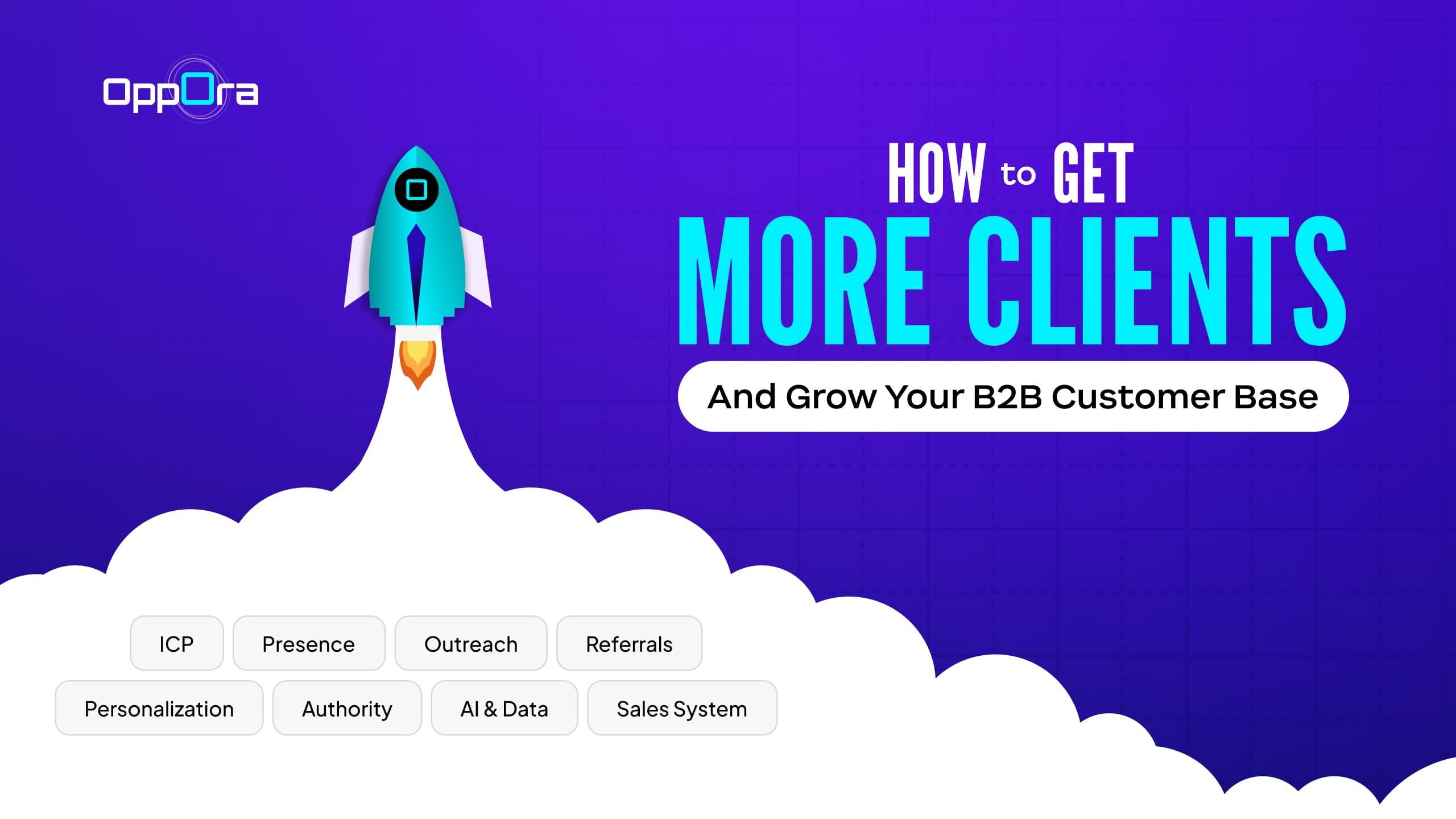
In this guide, we’ll break down proven strategies to get more clients, expand your B2B customer base, and create a scalable client acquisition system.
Before learning how to get new clients, it’s important to understand why the process has become more complex.
Modern B2B buyers are:
In fact, businesses that use structured client acquisition processes and automation often increase efficiency and generate more leads without increasing costs.
This means companies that rely only on cold outreach or referrals will struggle to scale. Instead, you need a systematic approach that combines marketing, sales, and technology.
One of the biggest mistakes companies make when trying to find more clients is targeting everyone.
The most successful B2B companies clearly define their Ideal Customer Profile (ICP).
Your ICP should include:
For example:
Instead of targeting “Marketing teams”
A better ICP would be: B2B SaaS companies with 20–200 employees looking to scale outbound sales.
This clarity helps you:
Without a defined ICP, your outreach becomes generic and ineffective.
Before contacting your company, most prospects will research you online.
This means your digital presence should clearly communicate:
Important elements include:
Content marketing is one of the most widely used B2B strategies, with over 90% of B2B marketers using content to attract and engage potential clients.
Publishing helpful content also builds trust and positions your company as an industry expert.
Read More: B2B Lead Magnets
Relying on a single channel to acquire clients is risky. Instead, successful B2B companies use multi-channel outreach strategies.
This typically includes:
Businesses that engage prospects across multiple channels often see significantly higher conversions compared to single-channel strategies.
For example:
A SaaS company may:
This layered approach builds familiarity and increases response rates.
Generic outreach messages rarely work in B2B sales.
Decision-makers receive dozens of messages every week, so personalization is critical.
Instead of sending messages like:
“Hi, we help businesses grow. Let’s connect.”
Try something more relevant:
“Hi Sarah, I noticed your company recently expanded into Europe. Many SaaS companies face lead generation challenges during international expansion. We recently helped a similar company increase qualified meetings by 40%. Would it make sense to share what worked?”
Personalized outreach significantly improves engagement and response rates because it shows you understand the prospect’s challenges.
Another powerful way to get new clients is by positioning your company as a trusted industry expert.
This can be done through:
Thought leadership helps potential clients discover your business before they start actively searching for solutions.
For example:
A cybersecurity company might publish:
This attracts decision-makers who are already looking for solutions.
Modern B2B sales teams increasingly rely on AI tools and automation platforms to manage prospecting and outreach.
These tools help businesses:
AI-powered marketing tools have been shown to significantly improve lead generation and client acquisition for many businesses.
Instead of manually managing outreach, teams can automate repetitive tasks and focus on building relationships with potential clients.
Your existing clients can be one of your most powerful growth channels.
Satisfied customers often refer businesses within their network, especially in B2B industries where trust plays a major role in purchasing decisions.
You can encourage referrals by:
Referrals tend to convert faster because prospects already trust the recommendation.
Getting more clients isn’t only about generating leads.
You also need an effective sales process that converts prospects into customers.
This includes:
Companies that implement structured sales processes often reduce acquisition costs and close deals faster.
Managing prospect lists, outreach campaigns, and follow-ups manually can quickly become overwhelming for growing sales teams.
This is where platforms like Oppora.ai help simplify the process.
Oppora is an AI-powered outbound sales platform that helps teams manage prospecting and outreach from a single system.
Sales teams can use it to:
Instead of juggling multiple tools, teams can build structured outbound campaigns that maintain personalization while scaling their outreach efforts.
This allows businesses to reach more prospects while maintaining meaningful conversations with potential clients.
Getting more clients in B2B markets isn’t about sending thousands of messages or chasing every lead.
It’s about building a repeatable client acquisition system that combines:
Businesses that combine these strategies can consistently attract new clients, strengthen relationships, and scale their customer base.
As markets become more competitive, companies that adopt structured, data-driven outreach strategies will be the ones that grow faster and build sustainable pipelines of qualified clients.
Lead generation focuses on attracting potential prospects who may be interested in your product or service, while client acquisition refers to converting those leads into paying customers. A successful B2B strategy combines both—generating qualified leads and nurturing them through outreach, follow-ups, and sales conversations.
Businesses can measure client acquisition success using metrics such as the number of qualified leads generated, response rates from outreach campaigns, conversion rates from prospects to customers, and customer acquisition cost (CAC). Tracking these metrics helps companies understand which strategies are working and where improvements are needed.
Many prospects do not respond to the first outreach message because they may be busy or not ready to engage at that moment. Consistent and thoughtful follow-ups help keep the conversation active and show professionalism. In many cases, deals are closed only after several interactions with a potential client.
The number of outreach messages needed can vary, but consistency is key. Most successful B2B sales strategies involve multiple touchpoints, including connection requests, follow-up messages, and emails. A structured outreach sequence helps increase response rates and keeps conversations active.
Some common mistakes include targeting the wrong audience, sending generic outreach messages, failing to follow up, and relying on only one lead generation channel. Businesses that take a strategic approach to prospecting and relationship building are more likely to attract qualified clients.
Small businesses can compete effectively by focusing on niche markets, offering personalized service, and building strong relationships with clients. Thought leadership content, targeted outreach, and specialized expertise often allow smaller companies to stand out against larger competitors.
Summarize with AI
Share