Home
Blog
Find 500 B2B Contacts for Free Every Month with Built-In Outreach.
Home
Blog
Manasa Goli
Published January 21, 2026
7 min
Try Oppora AI
Create Self-Running Agentic Sales Workflows like N8N just by chatting with AI
Get Started for FREE
Outbound sales hasn’t disappeared — it has evolved.
While new channels and tools continue to emerge, most B2B teams still rely on two classic methods to start conversations with prospects: cold email and cold calling.
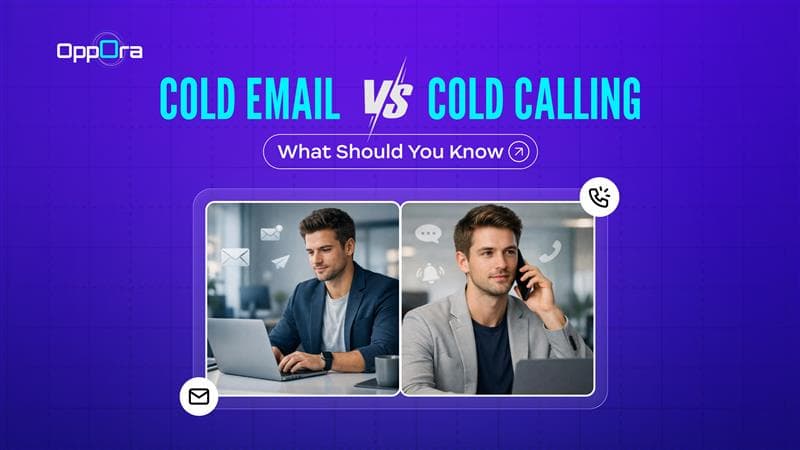
The debate around cold email vs cold call isn’t about which channel is “better.” It’s about when, why, and how each channel should be used — especially in a buyer-driven market where attention is limited and trust is hard to earn.
This guide breaks down:
At a surface level, the difference seems obvious — one uses email, the other uses phone calls. But the real distinction lies in how buyers experience each channel.
Cold email is asynchronous. You send a message, and the prospect decides when — or if — to engage.
From the buyer’s perspective:
From the seller’s perspective:
Cold calling is synchronous and interruptive. It demands attention immediately.
From the buyer’s perspective:
From the seller’s perspective:
This difference in buyer control is what drives most modern outbound decisions.
Cold email is the better choice when:
Example workflow:
Cold email creates permission-based momentum.
Cold calling works best when:
Example:
Here, the call feels contextual — not random.
Cold calling scales linearly. One rep equals one phone.
Even a highly disciplined SDR can only make so many calls per day — and only a fraction of those connect.
Cold email, by contrast, scales with systems:
This is why email is now the backbone of most outbound motions.
Cold calling personalization happens in real time. The rep adjusts based on tone, objections, and conversation flow.
Cold email personalization happens before sending — and this is where most teams struggle.
Example:
The second works because it’s contextual, not generic.
The challenge is doing this at scale, consistently, without burning hours on research.
Cold calling follow-up is fragile:
Cold email follow-up is structured:
A typical cold email workflow might look like:
This predictability is why email outperforms calls as a starting channel.
Cold calling is expensive in human terms:
Cold email reduces pressure:
That doesn’t mean email is “easier” — it just shifts effort from dialing to thinking and writing.
Smart outbound today isn’t cold call vs cold email — it’s cold email + intelligent sequencing + data-driven action backed by automation.
Most teams frame the problem as a channel decision:
“Should we invest more in cold calls or cold emails?”
But in practice, both fail for the same underlying reasons — not because email or calls are broken, but because the inputs to outbound are weak.
Here’s what actually causes outbound performance to plateau:
If your list is off, both cold calls and cold emails fail — just in different ways.
When sellers talk about “cold email not working,” it’s often because the prospect was never a fit to begin with.
Cold email relies heavily on relevance. Without accurate company data, role clarity, and buying signals, emails become vague and self-focused.
This is why many teams see:
When prospecting, enrichment, and outreach are handled manually:
Cold calling exposes these issues faster, but cold email suffers quietly — giving the illusion that the channel itself is the problem.
Cold email works only when four things happen together:
Most teams struggle to maintain all four — which is why the cold email vs cold call debate persists.
The issue isn’t choosing the wrong channel. It’s running cold email without the infrastructure it requires.
Oppora does not support cold calling.
Oppora.ai is built specifically to strengthen the cold email side of outbound, so that email becomes a reliable way to:
Below is how Oppora.ai supports cold email — step by step.
Cold email performance is directly tied to targeting quality.
Oppora.ai uses AI-powered lead discovery to help teams:
This ensures your emails reach people who are more likely to care, reducing wasted outreach and improving reply quality.
Cold email personalization fails when context is missing.
Oppora.ai automatically enriches leads with:
This allows teams to write emails that reference real situations, not assumptions.
Instead of:
“I wanted to introduce our product…”
You can lead with:
“Noticed your team is expanding SDR hiring — usually a sign pipeline targets are increasing.”
That difference is what turns cold email from noise into a conversation starter.
Cold email isn’t a single message — it’s a system.
Oppora.ai enables teams to run:
This consistency is critical. Most replies happen on follow-ups, not first emails — and Oppora.ai ensures those follow-ups actually go out.
Since Oppora.ai focuses on email, it plays a key role before cold calls ever enter the picture.
By tracking:
Teams can identify which prospects are showing intent — and only then decide if a call makes sense.
In this way:
One of the biggest reasons cold email fails is fatigue.
Reps burn out from:
Oppora automates the repetitive parts of cold email execution while leaving messaging strategy and conversations in human hands.
The result:
When cold email is supported properly:
Oppora strengthens cold email so it can do its job — warming, qualifying, and prioritizing prospects — instead of being treated as a numbers game.
Oppora doesn’t try to replace cold calls or blur the line between channels. Instead, it strengthens cold email as the first and most scalable layer of outbound — helping teams identify the right prospects, send relevant messages, and generate real engagement signals.
When cold email is executed properly, the decision to call becomes clearer, more intentional, and far less wasteful.
Cold email vs cold call isn’t about choosing a winner — it’s about understanding when and how each channel works best.
Cold email allows you to scale, test messaging, and generate engagement signals without exhausting your team. Cold calling still has a role, but it’s most effective after email has qualified interest.
The key to modern outbound success is combining data-driven targeting, personalized messaging, and structured follow-ups. Platforms like Oppora make this possible by automating prospect discovery, enriching contact data, and running multi-step cold email sequences — turning email into a reliable foundation for your sales process.
When executed correctly, cold email becomes more than just an outreach channel; it becomes the signal engine that guides smarter, more intentional calls — helping teams focus their efforts on prospects who actually engage.
In most cases, starting with cold email is more efficient. Email warms the prospect, provides engagement signals, and lets you prioritize who is worth calling.
Industries with busy decision-makers, complex schedules, or global teams — like SaaS, tech, and B2B services — often see higher ROI from cold email. It allows outreach to scale across regions and time zones without overwhelming prospects.
Track engagement signals like email opens, link clicks, and replies. When a prospect shows interest, a call becomes contextual rather than random, improving your chances of meaningful conversation.
Failure usually isn’t the channel—it’s the setup. Poor targeting, weak personalization, inconsistent follow-ups, and lack of verified data all reduce email effectiveness. Tools like Oppora address these issues by automating discovery, enrichment, and multi-step sequences.
Absolutely. Cold email remains the most scalable, measurable, and permission-friendly way to start conversations with busy prospects — especially when combined with AI-driven workflows to increase relevance and engagement.
Summarize with AI
Share