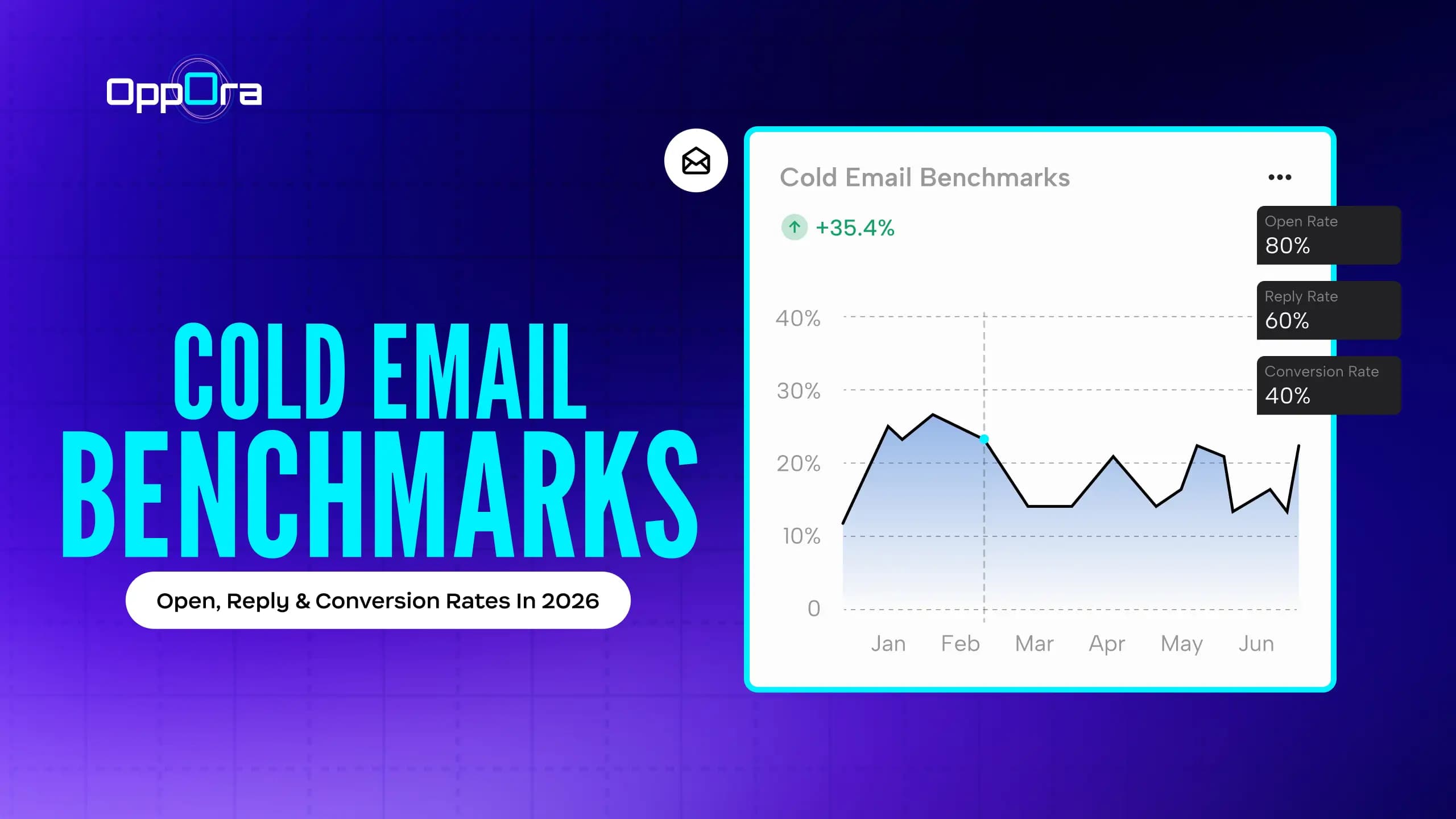
Cold Email Benchmarks: Open, Reply & Conversion Rates in 2026
Adam Hossain
Published February 3, 2026
15 min
Complete Agentic Email Outreach
AI agents find and enrich prospects, personalize emails, follow up, and handle replies with your meeting link.
Claim Your FREE Credits
You just sent 500 cold emails last week. Fifteen people opened them. Two replied.
Is that normal, or is your campaign broken?
Most sales teams ask this question and get vague answers, because cold email benchmarks change fast and mean different things depending on who's reporting them. What counted as a "good" reply rate in 2024 might be average today, and open rates barely tell you anything anymore.
This guide breaks down where your numbers should actually land in 2026, including:
- Open, reply, and bounce rate benchmarks by industry
- What separates top-performing campaigns from average ones
- How to diagnose exactly where your funnel is leaking
Cold Email Benchmarks 2026 at a Glance
Before you dive into the details, it helps to see the full picture first.
You just sent a batch of cold emails and now you're staring at the numbers, wondering if they're actually good.
Here's a quick snapshot of where things stand across every major metric in 2026, why those numbers have shifted since 2024, and which ones actually deserve your attention this year instead of the ones you've been chasing.
Average vs Good vs Top-Performing Cold Email Benchmarks
Most teams compare themselves to a single "average," but that number hides more than it reveals.
Cold email performance varies significantly based on your audience, targeting, list quality, and deliverability. Discussions in the HubSpot Community generally place cold email open rates around 30–50% and reply rates anywhere from 2–10%.
That gives you a more practical range to work with:
- Open rate — Around 30–50% can be a useful directional range, although privacy features make opens increasingly unreliable.
- Reply rate — Around 2–10%, with stronger targeting and relevance often determining where you fall within that range.
- Spam complaint rate — Keep this below 0.1% where possible and avoid reaching 0.3% or higher, based on Google's email sender guidelines. Yahoo's sender best practices similarly require bulk senders to stay below a 0.3% spam complaint rate.
These aren't hard performance targets. Your industry, audience, sending volume, and campaign setup can move the numbers considerably, so use them as directional benchmarks and compare them against your own campaign performance over time.
How Cold Email Benchmarks Changed From 2024 to 2026
Cold email has become harder to benchmark since 2024 as inbox providers tightened bulk-sender requirements.
In February 2024, Google introduced stricter sender requirements, including email authentication and easier unsubscribing.
Cold email still works, but relevance, targeting, timing, and sender reputation now matter more. So, older benchmarks may not accurately reflect how your campaigns should perform in 2026.
Which Metrics Matter Most in 2026?
Open rate used to be the headline metric. In 2026, you shouldn't rely on it alone.
Apple confirms that Mail Privacy Protection downloads remote email content in the background regardless of whether someone engages with the message, making true opens harder to identify.
Even Google's sender guidelines state that Google doesn't track open rates and can't verify the accuracy of third-party open-rate data.
So, use opens as a directional signal. Give more weight to replies, positive replies, conversions, and deliverability when judging whether your cold email campaign is actually working.
Email Open Rate Benchmarks in 2026
Open rate is usually the first number people check. It's also the one most likely to lead you astray.
Here's what counts as good in 2026, where it varies by audience, and why you shouldn't lean on it too heavily.
What Is a Good Cold Email Open Rate?
There isn't one universal cold email open rate you should aim for because results change with your audience, industry, and deliverability.
As a broader reference point, the GDMA International Email Benchmark 2026 reports a 34.2% global email open rate, based on its international email benchmark data.
For cold outreach, use that number as context rather than a strict target. More importantly, compare your opens with your own past campaigns, since privacy protections can make reported open rates less reliable.
Open Rates by Audience and Use Case
Open rates shift depending on who you're emailing and how your sends are set up:
- Raw, unmanaged lists — typically 15–25% opens
- Deliverability-managed sends (warmed domains, mailbox rotation, verified data) — often 60%+ opens
- Entry-level or individual contributor outreach — averages around 50% opens
- Executive or senior-level outreach — tends to run lower, given tighter inbox filtering and gatekeeping
The gap between these tiers usually comes down to setup, not subject lines.
What Open Rates Actually Measure and Why They Mislead
Here's the catch: nearly half of all opens today come through Apple Mail, which preloads tracking pixels automatically.
That means an email can register as "opened" before anyone actually reads it.
Treat open rate as a directional signal about deliverability, not a measure of interest. Reply rate tells you far more about whether your message is landing.
Cold Email Reply Rate Benchmarks in 2026
Open rate tells you if your email got seen. Reply rate tells you if it actually worked.
This is the metric worth building your entire benchmarking strategy around, so let's break down what good looks like and where it shifts.
What Is a Good Cold Email Reply Rate for B2B?
A good cold email reply rate for B2B in 2026 falls between 5% and 10%.
Anything above 10% puts you in excellent territory. The platform-wide average sits closer to 3–3.5%, which means most campaigns have real room to improve.
Reply Rates by Audience and Buyer Intent
Performance shifts depending on who you target and how tightly you build your list.
The GDMA International Email Benchmark found a clear difference by campaign size:
- Smaller campaigns (under 5,000 emails) — achieved a 37.6% open rate and 4.4% click-through rate
- Large campaigns (250,000+ emails) — dropped to a 26% open rate and 0.8% click-through rate
The study analyzed 521 billion emails, giving you a much broader data set than a typical platform benchmark.
While these are email engagement rather than cold-email reply rates, the pattern is useful: smaller, more targeted sends tend to generate stronger engagement than high-volume campaigns.
Positive Reply Rate vs Total Reply Rate
Not every reply means interest. A total reply rate lumps in "not interested," out-of-office bounces, and unsubscribe requests alongside genuine responses.
Positive reply rate strips that noise out. It only counts replies showing real buying intent, like a question or a meeting request.
Most strong campaigns see positive reply rates between 3% and 5%, with highly targeted outreach pushing past 10%. This is the number that should actually drive your strategy.
Cold Email Deliverability Benchmarks in 2026
None of the numbers above matter if your emails never reach the inbox in the first place.
Deliverability is the foundation everything else sits on, so let's look at what good actually looks like here.
What Is a Good Cold Email Bounce Rate?
A good cold email bounce rate in 2026 stays under 2–3%.
Here's how the tiers break down:
- Average — around 5%
- Good — under 2–3%
- Excellent — under 1.5%
Bounce rate is one of the clearest differentiators between top and bottom performers, and it usually comes down to how clean your list is before you hit send.
What Is an Acceptable Spam Complaint Rate?
Your spam complaint rate should stay below 0.1% whenever possible. According to Google's email sender guidelines, senders should also avoid ever reaching 0.3% or higher.
That upper threshold matters. Google says spam rates above 0.1% can already hurt inbox delivery, while bulk senders above 0.3% can become ineligible for delivery mitigations.
So, treat 0.1% as your working target rather than waiting until complaints approach the 0.3% limit.
What Is a Good Inbox Placement Rate?
Inbox placement measures whether your email actually lands in the primary tab, not spam or promotions.
There's no universal published benchmark here, since placement depends heavily on sender reputation and domain age.
But warmed domains with mailbox rotation and pre-send spam-trigger scoring consistently land in the primary inbox far more often than cold, unmanaged sends.
How Deliverability Affects Open and Reply Rates
Deliverability isn't a separate metric sitting off to the side. It's the multiplier behind every other number.
A message stuck in spam can't get opened, and it definitely can't get replied to.
That's why teams chasing better open or reply rates should check their deliverability setup first, long before they touch subject lines or copy.
Suggested Reading:
10 Best Email Deliverability Tools to Boost Inbox Rates FastCold Email Conversion and Meeting Booking Benchmarks
Replies feel good, but they don't pay the bills. Meetings and closed deals do. You can rack up dozens of responses each week and still miss quota if nothing converts.
This is where most benchmark reports stop being useful, since few teams track the funnel past reply rate. Here's exactly what the data shows once you follow it all through.
What Is a Good Cold Email Meeting Booking Rate?
Meeting booking rates are usually low because every step before the meeting, from deliverability to targeting and replies, affects the final conversion.
Research based on 28M+ cold emails analyzed with Gong found that the average sales rep needs to send 344 cold emails to book one meeting, or roughly 0.29% per email sent.
Top performers did significantly better, booking around 8x more meetings than average reps.
Just watch your denominator when benchmarking. A meeting rate based on emails sent isn't directly comparable with one calculated from unique prospects contacted.
Reply-to-Meeting Conversion Rate Benchmarks
Getting a reply is only step one. Turning that reply into a booked call is where most funnels quietly leak.
The full path looks like this:
- Reply — any response, including "not interested"
- Positive reply — genuine interest or a question
- Meeting booked — positive reply converts to a scheduled call
- Meeting held — the booked meeting actually happens
Most healthy campaigns book meetings from 1.5–3% of prospects showing positive reply intent, with follow-up speed and calendar friction determining where you land in that range.
Meeting-to-Opportunity and Closed-Deal Benchmarks
Not every meeting turns into pipeline, and not every opportunity closes.
According to Benchmarkit's sales development research, 56% of organizations convert 50% or less of their meetings into pipeline opportunities.
The drop-off continues further down the funnel. The same research found that 62% of organizations have an opportunity-to-closed/won conversion rate of 25% or less.
That is why meeting volume alone can be misleading. You need to track how many meetings create real opportunities and how many of those opportunities ultimately become revenue.
Cold Email Benchmarks by Industry
The same email performance can mean something very different depending on who you are targeting.
That is why comparing your results with one global number can be misleading. The GDMA International Email Benchmark analyzed 847 billion emails across 61 countries and found substantial differences in engagement between sectors.
Let's look at what those differences mean when you're benchmarking your own outreach.
B2B SaaS and Technology Benchmarks
SaaS and technology sit toward the lower end of reply rate benchmarks, typically landing between 1% and 6%.
Enterprise SaaS runs closer to 1–3%, since buyers face longer cycles and heavier inbox competition.
SMB-focused SaaS performs better, often reaching 3–6%, because decision-makers are easier to reach directly.
Agency and Consulting Benchmarks
Agencies and consultants tend to outperform SaaS, usually landing between 4% and 7%.
The advantage comes from specificity. Referencing a prospect's actual website, ad copy, or content performance before asking for anything proves expertise upfront, which pushes reply rates well above the general average.
Professional Services Benchmarks
Professional services, including legal, cover a wide range depending on how specialized the offer is.
Legal services often reach up to 10% reply rates, among the highest of any vertical. Financial services sit much lower, typically 2–4%, given compliance sensitivity and heavier gatekeeping.
Recruiting and Staffing Benchmarks
Recruiting and staffing consistently lead every industry benchmark, averaging 5% to 8% reply rates.
The reason is simple. A cold email to a hiring manager with an active opening solves an immediate problem, while most sales outreach asks someone to spend money instead.
Why Benchmarks Differ by Industry
The differences aren't random. The GDMA's international benchmark data shows that email engagement varies across industries, markets, and campaign types.
Several factors can explain why your results differ:
- Inbox saturation — how many competing messages your recipient receives
- Buying cycle — how much consideration happens before someone takes action
- Audience relevance — how closely your offer matches an immediate need
- Gatekeeping and compliance — how much friction exists before a buyer can engage
So, start with your own industry and audience when setting a benchmark. Then compare similar campaigns over time instead of assuming one global reply rate defines good performance.
What Separates Top-Performing Cold Email Campaigns
The gap between average and excellent rarely comes down to one big lever. It's usually five smaller ones working together.
Here's what shows up consistently across the campaigns that outperform every benchmark in this guide.
ICP Targeting and List Quality
Every top-performing campaign starts with a narrow, well-verified list.
Cutting a broad target like "all SaaS companies" down to something specific, such as Series B fintech companies with a newly hired VP of Sales, routinely doubles reply rates. A sharper list makes a sharper message possible.
Suggested Reading:
How To Find Your Target Audience for Cold Emailing (Complete Guide)Micro-Segmentation and Personalization
Generic personalization tokens rarely move the needle anymore.
What works instead is grouping prospects into tight segments and writing messaging specific to each one. A first line tied to a real, verifiable trigger consistently outperforms a simple first-name swap.
Suggested Reading:
How To Find Your Target Audience for Cold Emailing (Complete Guide)Email Length, Messaging, and CTA
Shorter emails with one clear ask consistently beat long, feature-heavy pitches that try to cover everything at once. Readers skim fast, so extra density usually works directly against you right here.
Vague CTAs like "let me know if you're interested" create friction. Specific asks, like offering to draft something concrete for free, remove the guesswork and make replying easier.
Follow-Up Sequence Length and Timing
Most replies don't come from the first email.
A well-built sequence runs four to seven touches over three to four weeks, since a meaningful share of total replies come from follow-ups rather than the initial send. Stopping after one or two emails leaves real pipeline on the table.
Suggested Reading:
AI Follow-Up Automation: How to Turn More Conversations Into Booked MeetingsBuying Signals and Right-Time Outreach
Timing often matters more than copy. Elite teams trigger outreach around signals that suggest a prospect is actually ready to engage:
- Hiring activity — new roles tied to your offer
- Funding announcements — fresh budget and urgency to grow
- Product launches — a natural reason to reach out
- Website visits — active research already in motion
Hitting a prospect right after one of these signals fires consistently outperforms outreach sent at random.
How to Diagnose Cold Email Performance Against Benchmarks
Benchmarks tell you exactly where you stand today, across every metric you happen to track closely. They don't tell you why your numbers landed there in the first place.
That's where diagnosis comes in. Each metric points to a specific part of your funnel, so once you know exactly where you're falling short, you know precisely what to check first.
High Bounce Rate — Check Lead Data and Email Verification
When your bounce rate starts climbing, check the quality of your contact data first.
Invalid, outdated, and poorly maintained addresses can quickly become a deliverability problem.
Yahoo's sender best practices specifically recommend monitoring hard and soft bounces and removing invalid recipients promptly.
Verify addresses before sending and regularly clean contacts that are no longer reliable or active.
Low Open Rate — Check Deliverability and Sender Reputation
A low reported open rate can point toward a deliverability problem, but don't treat it as proof your subject line failed. Google's email sender guidelines state Google doesn't track opens and can't verify third-party open-rate accuracy.
Check what actually matters instead:
- Authentication — confirm SPF, DKIM, DMARC
- Sender reputation — monitor domain and IP health
- Sending volume — scale gradually
- Spam complaints — stay under 0.1%
Good Open Rate but Low Reply Rate — Check Targeting and Messaging
Strong opens with weak replies usually mean people are seeing your email and deciding it's not for them.
This is a targeting problem, not a deliverability one. Narrow your ICP, and make sure your first line references something specific and real about the recipient.
Good Reply Rate but Low Meeting Rate — Check CTA and Reply Handling
If replies are healthy but meetings aren't following, look closely at what actually happens right after someone responds to your cold email. The gap usually isn't your original pitch anymore at this exact point.
A vague CTA, a clunky booking link, or a slow reply turnaround all quietly kill momentum right when interest peaks and the prospect is paying attention.
Good Meeting Rate but Low Pipeline — Check Qualification and Buyer Intent
Booking meetings that don't turn into pipeline usually means you're optimizing for volume over fit.
Revisit your qualification criteria before the meeting happens, not after. A tighter buyer-intent filter upfront saves far more time than sales calls that were never going to close.
How Oppora Helps Improve Cold Email Performance
Every benchmark above points back to the same root causes: bad data, weak deliverability, generic targeting, and disconnected follow-up.
Oppora is an AI sales platform built specifically to close those exact gaps for good. It runs lead sourcing, verification, outreach, and reply handling through connected AI agents, instead of leaving your team to patch each piece separately with different tools.
Improve Lead Quality and Reduce Bounce Rates
Oppora sources leads through waterfall enrichment, pulling from its 700M+ contact database and multiple verified providers rather than relying on a single source.
Every contact runs through built-in, real-time email verification before it reaches a campaign.
That's what keeps your bounce rate closer to the "excellent" tier instead of the industry average.
Protect Sender Reputation and Inbox Placement
Oppora auto-warms new domains and rotates outreach across up to 50 mailboxes, so no single inbox absorbs enough volume to trigger spam filters.
It also matches sender identity automatically, sending Gmail-to-Gmail and Outlook-to-Outlook, which improves both open rates and trust with receiving servers.
Improve Reply Rates With AI Targeting and Personalization
Every email Oppora sends is uniquely generated, not pulled from spintax or recycled templates.
Combined with intent and buying-signal filters, this lets you reach the right prospect with a message that actually reflects their context, which is exactly the combination top-performing campaigns rely on.
Scale Outreach With Inbox and Domain Rotation
Growing volume usually means growing risk. Oppora's inbox rotation and warmup system separates the two.
You can scale from a handful of mailboxes to dozens without your sending pattern looking artificial to inbox providers, keeping deliverability steady as your list grows.
Automate Reply Handling and Meeting Booking
Oppora's AI Reply Agent works directly from your inbox, so replies never sit unanswered while momentum fades.
It handles the full conversation loop:
- Answering questions as they come in
- Sending attachments when requested
- Handling objections without manual input
- Qualifying interest before it reaches your calendar
- Booking meetings automatically once intent is confirmed
Track the Full Outbound Workflow From Lead to Meeting
None of this matters if you can't see where the funnel is actually working.
Oppora syncs contacts, replies, and booked meetings directly to HubSpot, Salesforce, Pipedrive, or its built-in CRM, giving you one place to trace performance from first send to closed deal instead of piecing it together across tools.
Conclusion
Cold email benchmarks in 2026 reward precision over volume. Open rate barely tells you anything anymore, reply rate and positive intent do, and your real target depends entirely on your industry, not a single blended average.
The teams pulling ahead treat every stage of the funnel as connected, from list quality through reply handling, rather than optimizing one metric in isolation.
If keeping that whole chain tight feels like a full-time job, that is exactly the gap Oppora was built to close, running lead sourcing, deliverability, and reply handling together so your numbers move as one system instead of five.
Frequently Asked Questions (FAQs)
What Is a Good Cold Email Open Rate in 2026?
Open rate benchmarks vary widely and should be treated cautiously. Apple's Mail Privacy Protection preloads tracking pixels on a large share of inboxes, inflating reported opens. Most senders aim for 40–60%, but reply rate is the more trustworthy signal for actual engagement.
What Is a Good Cold Email Reply Rate for B2B in 2026?
A well-run B2B campaign typically lands between 5% and 10%. According to Backlinko's study of 12 million outreach emails, the average response rate sits near 8.5%, with follow-ups accounting for a meaningful share of that number.
What Is a Good Positive Reply Rate?
Positive reply rate, meaning replies that show genuine interest, typically falls between 3% and 5% for solid B2B campaigns. Highly targeted, well-personalized outreach can push this past 10%. It's a more reliable success metric than total replies, since it filters out noise.
What Is a Good Cold Email Bounce Rate in 2026?
A good bounce rate stays under 2%, well below the acceptable ceiling most inbox providers enforce. Google's bulk sender guidelines also require spam complaint rates below 0.1%, since bounce and spam issues both damage sender reputation together.
How Many Follow-Ups Should a Cold Email Sequence Have?
Most effective sequences run four to seven touches. Backlinko found a single follow-up lifts reply rates by 65.8%, and HubSpot research shows roughly 80% of successful sales require five or more follow-up attempts before a prospect responds.
Summarize with AI
Share