Home
Blog
Find 500 B2B Contacts for Free Every Month with Built-In Outreach.
Home
Blog
Adam Hossain
Published March 15, 2026
7 min
Try Oppora AI
Create Self-Running Agentic Sales Workflows like N8N just by chatting with AI
Get Started for FREE
Moving a potential customer from first contact to a signed deal rarely happens by accident.
Without a clear structure, opportunities slip through the cracks and sales teams struggle to predict revenue.
This is where B2B sales pipeline stages become essential.
They break the sales process into clear steps, helping you track prospects, prioritize deals, and understand exactly where each opportunity stands.
When your pipeline stages are defined well, your team knows what action to take next.
As a result, you create a more consistent sales process and a far more predictable growth engine.
A B2B sales pipeline is a structured way to track how potential customers move from first contact to a closed deal.
Instead of managing opportunities randomly, the pipeline breaks the sales journey into clear stages such as prospecting, qualification, and negotiation.
Each stage represents a specific action your sales team must take to move a deal forward.
This structure helps you see where every opportunity stands, prioritize the right leads, and forecast revenue more accurately.
When your pipeline stages are clearly defined, your team spends less time guessing and more time selling.
Although people often use these terms interchangeably, they represent two different perspectives.
The sales pipeline focuses on the actions your sales team takes to move deals forward.
The sales funnel, on the other hand, focuses on the buyer’s journey and how many prospects convert at each stage.
Think of the pipeline as the sales team's workflow, while the funnel shows how prospects move toward becoming customers.
Now that you understand what a B2B sales pipeline is, the next step is knowing how it actually works in practice.
Most B2B sales processes follow a structured set of stages that guide prospects from first contact to a closed deal.
Each stage represents a key step your sales team takes to move an opportunity forward.
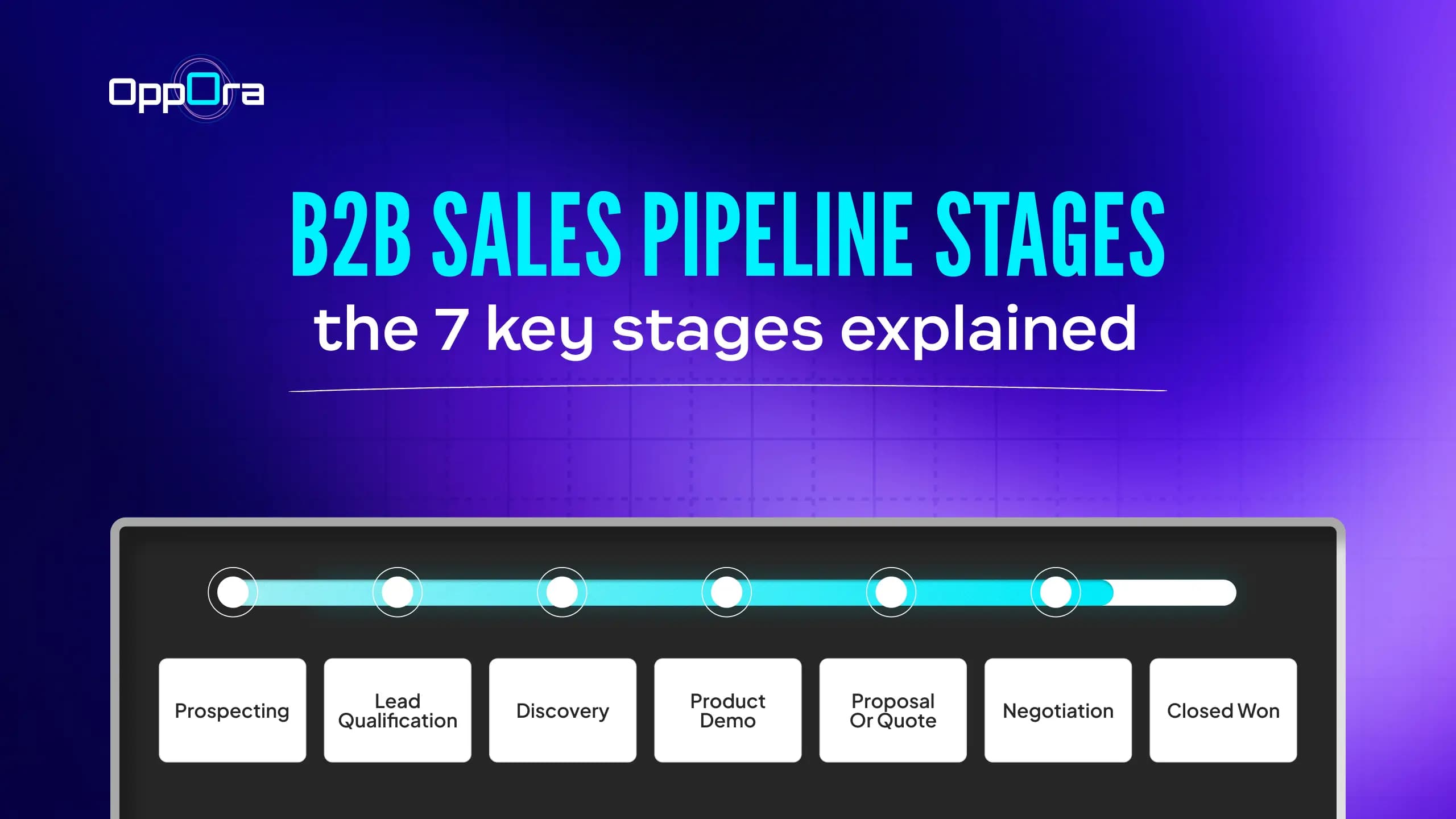
Below are the seven core B2B sales pipeline stages that help teams track progress, prioritize deals, and create a more predictable sales process.
Prospecting is the first stage of the B2B sales pipeline.
At this stage, your goal is to identify potential customers who might benefit from your product or service.
Sales teams focus on building a list of companies and decision-makers that match their ideal customer profile.
Common prospecting methods include:
The goal is not to sell immediately.
Instead, you are simply identifying potential opportunities and starting initial conversations with the right people.
Strong prospecting ensures your pipeline is always filled with new opportunities.
Not every prospect is the right fit for your solution.
That is why the next stage focuses on lead qualification.
Here, sales teams determine whether a prospect has the right characteristics to become a real opportunity.
This usually involves evaluating factors such as:
Many teams use structured frameworks like BANT (Budget, Authority, Need, Timeline) or MEDDIC to guide qualification.
The purpose of this stage is to filter out low-potential leads and focus on prospects who are most likely to convert.
A well-qualified lead becomes a sales-qualified lead (SQL) and moves forward in the pipeline.
Once a lead is qualified, the next step is understanding the prospect’s situation in detail.
This happens during the discovery stage.
The goal here is to learn about the prospect’s challenges, goals, and current processes.
Sales representatives usually conduct discovery calls where they ask questions such as:
This conversation helps sales teams clearly understand the prospect’s pain points and priorities.
A successful discovery stage ensures that any future presentation or proposal directly addresses the buyer’s real needs.
Once you understand the prospect’s challenges, it becomes easier to show how your solution can help.
This is where the product demo or presentation stage comes in.
Instead of giving a generic product tour, effective sales teams customize their demo based on what they learned during discovery.
The presentation should clearly demonstrate:
One common mistake in this stage is focusing too much on features.
Successful demos focus on business value and outcomes, not just product functionality.
When done well, this stage builds confidence and moves the buyer closer to making a decision.
If the prospect shows strong interest after the demo, the conversation moves toward pricing and formal details.
This is the proposal stage.
At this point, the sales team delivers a document that outlines the proposed solution, pricing structure, and terms of the agreement.
A strong B2B proposal usually includes:
Before sending the proposal, many successful sales teams ensure all key stakeholders are aligned.
This reduces surprises and increases the chances of moving smoothly to the next stage.
After reviewing the proposal, prospects often have questions, concerns, or requests for adjustments.
This is where the negotiation stage begins.
Discussions may include:
Negotiation is not only about price.
It is also about ensuring both sides feel confident about the partnership.
Experienced sales professionals focus on maintaining value rather than immediately offering discounts.
If the process goes smoothly, the deal moves toward final approval.
The final stage of the pipeline determines the outcome of the deal.
If the prospect accepts the proposal and signs the agreement, the deal is marked as Closed Won.
At this point, the customer typically moves into onboarding and implementation.
Many companies also hand off the relationship to a customer success team to ensure long-term satisfaction.
However, not every deal results in a sale.
If the prospect decides not to move forward, the opportunity becomes Closed Lost.
While losing deals can be frustrating, they provide valuable insights.
Analyzing lost deals helps sales teams improve messaging, qualification, and future pipeline strategies.
Understanding your pipeline stages is important, but tracking the right metrics is what helps you improve them.
Sales metrics show where deals move smoothly and where opportunities start slowing down.
By analyzing these numbers regularly, you can identify weak points in your sales process and make smarter decisions.
Some of the most important metrics to track include:
This shows the percentage of prospects moving from one stage to the next.
If many deals drop after the demo stage, for example, it may indicate messaging or product fit issues.
Pipeline velocity measures how quickly deals move through your sales pipeline.
A faster velocity means your team is closing deals efficiently and generating revenue sooner.
This metric tracks the typical value of a closed deal.
Understanding deal size helps forecast revenue and identify high-value opportunities.
Win rate represents the percentage of opportunities that become closed deals.
Monitoring this metric helps you evaluate how effective your sales process is overall.
When tracked consistently, these metrics provide valuable insights that help optimize your entire B2B sales pipeline.
Even when companies build a structured sales pipeline, mistakes in managing it can slow down deals and reduce conversion rates.
Understanding these common issues helps you keep your pipeline clean, efficient, and predictable.
Some sales teams create overly complex pipelines with too many stages.
This makes it harder to track deals and slows down decision-making.
A simple, clearly defined pipeline is usually more effective.
When unqualified leads enter the pipeline, sales teams spend time chasing opportunities that are unlikely to close.
Strong qualification ensures your team focuses only on prospects who truly match your ideal customer profile.
If pipeline stages are vague, sales reps may move deals forward too early.
Each stage should have clear criteria that explain when an opportunity is ready to move to the next step.
Many teams track deals but ignore the data behind them.
Without monitoring metrics like conversion rates, win rates, and pipeline velocity, it becomes difficult to improve performance.
Avoiding these mistakes helps create a healthier pipeline and a more predictable B2B sales process.
Managing every stage of a B2B sales pipeline manually can quickly become overwhelming.
Sales teams often juggle multiple tools to find leads, write outreach emails, follow up with prospects, and track deals in a CRM.
This is where automation can transform the entire process.
Oppora automates the full B2B sales pipeline by connecting each stage into one intelligent workflow.
Instead of switching between tools, you simply define what you sell and who you want to reach.
From there, Oppora’s AI sales agents handle the rest.
The system can automatically:
Oppora also keeps your pipeline organized by syncing conversations, contacts, and deals directly into your CRM.
This means every stage of the sales process from prospecting to meeting booking runs in a connected system.
By automating repetitive tasks, your team can focus more on building relationships and closing deals instead of managing manual outreach.
A well-defined B2B sales pipeline helps you move prospects through each stage with clarity and consistency.
By structuring the journey from prospecting to closed deals, your team can track opportunities better, improve conversion rates, and create more predictable revenue.
However, managing every step manually can slow down growth.
This is where automation becomes valuable.
Platforms like Oppora help streamline the entire pipeline—from finding leads to sending outreach and booking meetings.
If you want a more efficient and scalable sales process, exploring tools like Oppora can be a smart next step.
The length of a B2B sales cycle depends on the product complexity, deal size, and number of decision-makers involved.Some deals may close in a few weeks, while enterprise-level agreements can take several months to finalize.
Most B2B sales pipelines contain between five and eight stages.The goal is to keep stages clear and manageable while still reflecting the real steps buyers take before making a decision.
Typically, sales managers oversee the pipeline while individual sales representatives manage their own deals.Leadership teams often review pipeline reports to forecast revenue and ensure opportunities are progressing properly.
Sales pipelines should ideally be reviewed weekly.Regular reviews help teams remove stalled deals, prioritize active opportunities, and identify where prospects are getting stuck in the sales process.
Yes, even small businesses benefit from having a clear sales pipeline.It helps founders and small sales teams organize leads, prioritize prospects, and build a repeatable sales process that supports consistent growth.
Summarize with AI
Share