Sales teams now use more tools than ever. But switching betweenprospecting, enrichment, outreach, follow-ups, and CRM updates still creates unnecessary work.
That is where AI sales workflow platforms can help. They connect different sales tasks and reduce the amount of manual work your team has to handle.
But not every platform automates sales in the same way.
In this guide, you will learn:
Which AI sales workflow platforms stand out in 2026
How their workflow capabilities compare
Which platform fits your sales team best
What to check before choosing one
Why Businesses Are Switching to AI Sales Workflow Platforms in 2026
Sales teams rarely struggle because they lack software. The bigger problem is that too many tools still require you to connect the process manually.
You may use one platform to find leads, another to enrich data, another to send emails, and aCRM to track everything afterward.
That setup works, but it creates friction as your outreach grows.
The hidden cost of disconnected sales tools
Every tool switch adds another task for your team.
Someone has to export leads, clean the data, move contacts between platforms, update campaign stages, monitor replies, and keep the CRM accurate.
Even when each tool works well on its own, the overallworkflow can still feel fragmented.
You also create more opportunities for duplicate records, missed follow-ups, outdated lead information, and inconsistent outreach.
That is why more businesses are moving toward platforms that connect multiple sales activities inside one workflow.
Instead of asking your team to manage every step, you can automate how one action triggers the next.
What an AI sales workflow platform should automate
A useful AI sales workflow platform should go further than writing emails or scheduling follow-ups.
It should help you connect the core parts of your sales process, including:
The real value comes from how these tasks work together.
When your platform can move a prospect from discovery to outreach and follow-up with fewer manual steps, your team spends less time managing tools and more time focusing on conversations that can turn into revenue.
The best platform depends on how much of your sales process you want AI to handle.
Some tools focus on prospecting or email execution. Others connect lead discovery, enrichment, outreach, replies, and CRM activity into a broader workflow.
Here is a quick comparison of the 12 platforms covered in this guide.
AI sales workflow platforms are transforming how modern sales teams operate by automating prospecting, outreach, follow-ups, and CRM updates in a single system.
Instead of relying on multiple disconnected tools, these platforms useAI agents to streamline the entiresales process, improve lead quality, and help teams close deals faster with less manual effort.
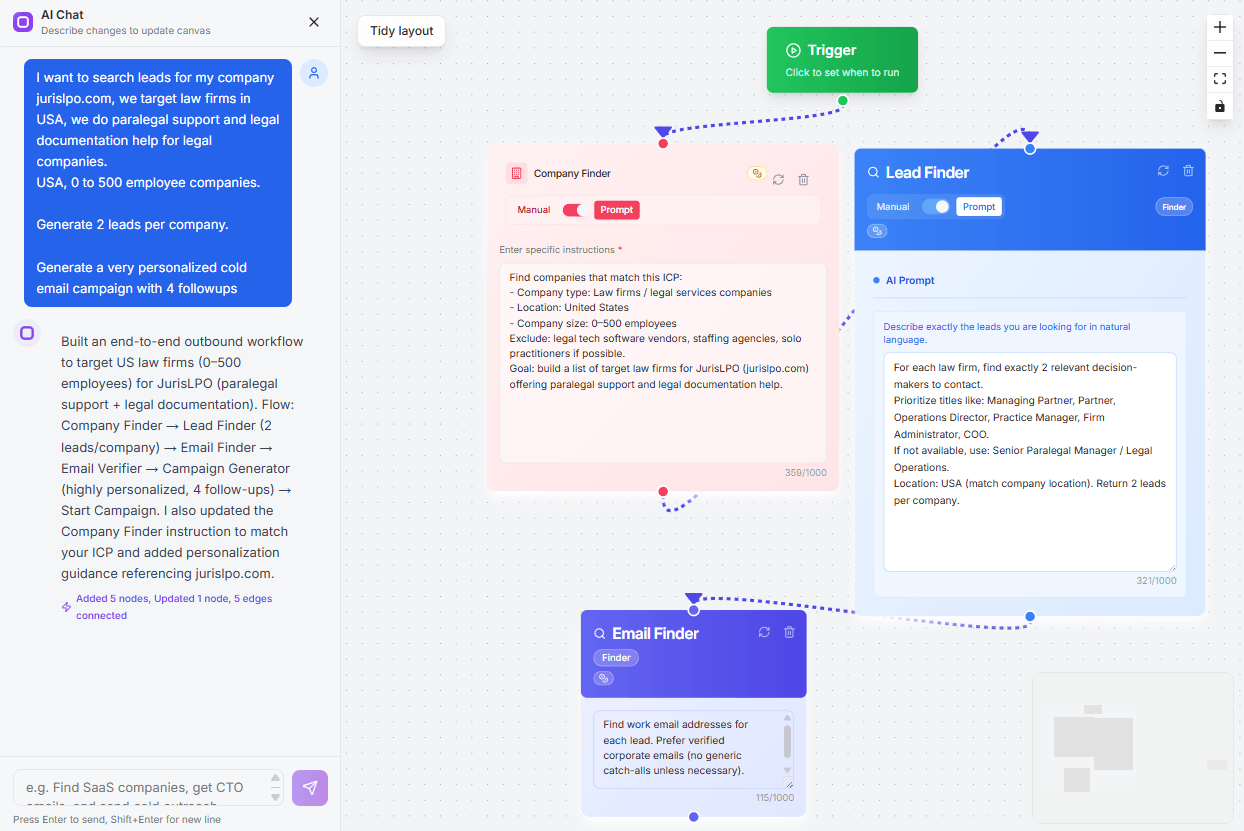
1. Oppora.ai — Best Overall AI Sales Workflow Platform ⭐
Oppora.ai is designed for teams that want to automate the complete outbound sales process instead of managing several disconnected tools.
You can build a workflow once, connect different AI agents, and let them handle prospecting, enrichment, outreach, replies, and CRM updates automatically.
Key Features
8 AI Sales Agents: Work together across prospecting, enrichment, outreach, replies, and CRM activities.
1B+ contact database: Access a large B2B database to find relevant companies, decision-makers, and prospects for targeted outreach.
Lead enrichment: Add useful prospect and company information before outreach begins.
Email verification: Validate contact information before adding leads to campaigns.
AI personalization: Generate unique email content instead of relying only on repeated spintext.
Multi-channel outreach: Combine email and LinkedIn activities inside connected workflows.
AI Reply Agent: Answer questions, handle objections, qualify prospects, and help book meetings.
Deliverability controls: Warm inboxes, rotate mailboxes, and match Gmail-to-Gmail or Outlook-to-Outlook sending.
CRM sync: Push contacts, replies, meetings, and deals into HubSpot, Salesforce, Pipedrive, or Oppora CRM.
Pros
One pricing structure covers lead generation, enrichment, and outreach.
Separate credits are available for different tasks instead of one shared credit pool.
Unused paid credits can roll over.
Unlimited campaigns are supported.
Email sending is unlimited within monthly recipient limits.
Extra credit packs can be purchased without upgrading the full plan.
Cons
Oppora is newer than long-established platforms such as Salesforce and HubSpot.
Its broader integration ecosystem is still developing.
Mini credit packs are also available for specific tasks such as email search.
Best For
Founders
Solopreneurs
SDR teams
Sales and marketing agencies
Staffing companies
IT service businesses
B2B teams that want end-to-end outbound automation
2. Apollo.io — Best for Prospecting and Sales Engagement
Apollo.io combines B2B prospecting data with sales engagement and workflow automation, making it useful when you want to find prospects and reach them from the same platform.
Key Features
230M+ contact database: Search B2B contacts and companies using detailed prospecting filters.
AI Assistant: Helps with list building, prospect research, enrichment, messaging, sequences, analytics, and automation.
Workflow automation: Automate prospecting tasks, lead actions, alerts, and sales processes.
Multi-channel sequences: Connect with prospects through email, calls, and LinkedIn touchpoints.
CRM enrichment: Update, enrich, and deduplicate existing customer and prospect records.
Pros
Combines prospecting data and outreach in one platform.
Strong AI support across multiple stages of outbound sales.
Useful for building and automating repeatable prospecting workflows.
Cons
Apollo uses credits across its plans, so teams with heavier data usage need to monitor consumption.
Complex outbound workflows may require more configuration than a fully autonomous agent-based system.
Pricing
Free: $0
Basic: $49/user/month, billed annually
Professional: $79/user/month, billed annually
Organization: $119/user/month, billed annually with a 3-seat minimum
Free trial: 14 days for eligible Basic or Professional plans.
Best For
SDR teams
B2B sales teams
Prospecting-heavy businesses
Teams wanting lead data and sales engagement in one platform
3. HubSpot Sales Hub — Best for CRM-Centered Sales Teams
HubSpot Sales Hub is a strong choice when you want your sales workflows, prospect data, pipeline, and CRM activity connected in one system.
Key Features
AI Prospecting Agent: Researches target accounts, identifies opportunities, and creates personalized outreach based on CRM and company data.
Sales workflows: Automate tasks, notifications, lead routing, and other actions based on CRM triggers. Professional supports up to 300 customizable workflows, while Enterprise supports up to 1,000.
Sequences: Build automated email and task sequences for structured follow-ups and prospect engagement.
Lead scoring: Prioritize prospects based on their fit and engagement.
Pipeline management: Track deals, sales activity, meetings, forecasts, and opportunities from the same CRM.
AI-powered account research: The Prospecting Agent can automatically research enrolled contacts and generate outreach strategies.
2,000+ integrations: Connect HubSpot with sales, productivity, communication, and data tools.
Pros
CRM data and sales automation remain connected in one platform.
Strong workflow, reporting, pipeline, and forecasting capabilities.
Suitable for teams that want sales and customer data in one system.
Free CRM tools provide an accessible starting point.
Cons
Advanced workflows, sequences, and sales automation require higher-tier plans.
AI features such as the Prospecting Agent use HubSpot Credits, which can increase overall usage costs.
Professional and Enterprise plans also include mandatory onboarding fees.
Pricing
Free: $0/month for up to 2 users
Starter: Starts at $7/user/month
Professional: Starts at $90/user/month
Enterprise: Starts at $150/user/month
Free trial: HubSpot currently offers a 14-day Sales Hub trial.
Best For
CRM-centered sales teams
Growing SaaS companies
Sales and RevOps teams
Businesses already using HubSpot
Teams that want prospecting, pipeline management, automation, and reporting connected to the same customer database
4. Clay — Best for Data Enrichment and Custom GTM Workflows
Clay is a strong option when your sales workflow depends heavily on prospect research, enrichment, buying signals, and custom data automation before outreach begins.
Key Features
150+ data providers: Access company and contact data from a large network of enrichment sources.
Waterfall enrichment: Automatically checks multiple providers until it finds the required data, helping improve coverage.
Claygent AI: Research companies and contacts using natural-language prompts and web-based AI research.
Intent and signal tracking: Monitor signals such as job changes and website activity to identify timely outreach opportunities.
CRM enrichment: Automatically enrich and sync prospect information with your CRM on higher plans.
Workflow integrations: Connect APIs, webhooks, email campaign tools, and other GTM systems to build customized workflows.
Pros
Excellent flexibility for building highly customized prospecting workflows.
Combines AI research with data from many enrichment providers.
Strong fit for signal-based outbound and account research.
Free plan includes waterfall enrichment and Claygent.
Cons
Building advanced workflows can require more setup and experimentation.
Full CRM automation, API integrations, and advanced signals require higher plans.
Teams mainly looking for simple cold-email automation may find Clay more complex than necessary.
Pricing
Free: $0/month
Launch: Starts at $185/month
Growth: Starts at $495/month
Enterprise: Custom pricing
Free trial: 14 days with 1,000 data credits.
Best For
GTM and RevOps teams
Data-heavy sales teams
Account-based marketing teams
Businesses building custom enrichment workflows
Teams that prioritize prospect data quality and research before outreach
5. Salesforce Einstein — Best for Enterprise CRM Automation
Salesforce Einstein brings AI directly into Salesforce CRM, helping you automate sales tasks while using existing customer, lead, and opportunity data.
Key Features
Einstein Lead Scoring: Prioritize leads based on their likelihood to convert.
Opportunity Scoring: Identify stronger opportunities and spot deals that may need attention.
AI sales emails: Generate personalized emails using Salesforce CRM data.
Agentforce: Use AI agents for prospect research, qualification, outreach support, and other sales activities.
Sales automation: Automate lead routing, activity capture, pipeline updates, and repetitive CRM tasks.
Conversation intelligence: Analyze sales conversations and give reps useful insights for follow-ups and coaching.
Forecasting and analytics: Use AI and CRM data to improve pipeline visibility and revenue forecasting.
Pros
AI works directly with your existing Salesforce CRM data.
Strong lead scoring, forecasting, and pipeline management capabilities.
Suitable for complex enterprise sales processes.
Agentforce adds more autonomous AI workflow capabilities.
Cons
More expensive than many standalone sales automation platforms.
Setup and customization can be complex for smaller teams.
Some advanced AI functionality is limited to higher-tier plans or additional products.
Pricing
Starter Suite: $25/user/month
Pro Suite: $100/user/month
Enterprise: $175/user/month
Unlimited: $350/user/month
Agentforce 1 Sales: $550/user/month
Free trial: 30 days
Best For
Enterprise sales teams
Salesforce users
Large RevOps teams
Businesses with complex pipelines
Teams that want AI automation deeply connected to CRM data
6. Outreach.io — Best for Enterprise Revenue Orchestration
Outreach.io is built for larger revenue teams that want to connect prospecting, engagement, deal management, forecasting, and coaching in one AI-powered platform.
Key Features
AI Revenue Agent: Identifies high-intent accounts, sources contacts, and generates personalized outreach.
Research Agent: Pulls insights from conversations, meetings, external sources, and account activity to improve targeting.
Deal Agent: Recommends updates to opportunity fields and helps reps keep deals on track.
Personalization Agent: Uses buyer context and research to create more relevant messaging across channels.
Agent Studio: Lets you automate sales motions using visual, pre-built workflows with triggers, conditions, research actions, and sequence routing.
Multi-channel sequences: Coordinate outreach, tasks, calls, meetings, and prospect engagement from one platform.
Pipeline and forecasting: Monitor deals, pipeline health, and revenue forecasts alongside engagement activity.
Pros
Covers prospecting, engagement, deal management, and forecasting in one system.
Strong AI agent capabilities for both SDRs and account executives.
Useful for complex revenue workflows involving multiple sales roles.
Agent Studio can automate repeatable sales motions without building every workflow from scratch.
Cons
Pricing is not publicly fixed, making upfront cost comparison harder.
AI usage is credit-based in addition to seat-based platform pricing.
Agent Studio currently relies on pre-built workflow templates and does not yet support fully custom branching inside those templates.
Pricing
Pricing: Custom quote
Uses a combination of seat-based pricing + AI consumption credits
Additional AI credit packs can be purchased when required.
Public fixed monthly pricing is not listed.
Best For
Enterprise sales teams
Mid-market revenue organizations
SDR and AE teams
Revenue operations teams
Businesses that need prospecting, engagement, pipeline management, and forecasting in one platform
7. Salesloft — Best for AI-Guided Revenue Workflows
Salesloft is built for revenue teams that want AI to prioritize seller actions, automate repetitive work, and guide reps through prospecting and deal execution.
Key Features
AI Agents: Automate research, generate personalized emails, recommend actions, and support sellers across the sales cycle.
Rhythm: Converts buyer signals into a prioritized list of actions, helping reps focus on prospects and accounts most likely to convert.
Rhythm Plays: Build workflows triggered by buyer activity, engagement signals, and sales events.
Custom sales workflows: Create unlimited custom Plays using your own sales data and connected tech stack.
Account prioritization: AI helps determine which accounts deserve attention based on their likelihood to progress or close.
Conversation intelligence: Uses buyer conversations as additional context for AI agents and seller recommendations.
AI Chat Agent: Engages website visitors, identifies qualified buyers, and sends relevant actions into seller workflows.
Pros
Strong AI-driven task prioritization for busy sales teams.
Combines seller workflows, buyer signals, AI agents, and sales engagement.
Helps reps decide what action to take next instead of simply generating more tasks.
Useful across prospecting, pipeline management, and revenue execution.
Cons
More suitable for established revenue teams than very small businesses.
Pricing is not publicly displayed, which makes direct cost comparison difficult.
Teams mainly needing simple lead search or cold email automation may not need its broader revenue orchestration capabilities.
Pricing
Pricing: Custom quote
Fixed monthly prices are not publicly listed.
You need to contact Salesloft for plan and pricing details.
Free trial: No standard public platform trial is currently listed; demos are available.
Best For
Mid-market sales teams
Enterprise revenue teams
SDR and AE organizations
Revenue operations teams
Businesses that want AI-guided workflows, buyer-signal prioritization, and sales engagement in one system
8. Instantly.ai — Best for High-Volume Cold Email Outreach
Instantly.ai is built for teams that want to combine lead sourcing, cold email outreach, deliverability, and AI-assisted reply handling in one workspace.
Key Features
450M+ B2B contact database: Use SuperSearch to find prospects and verified contact data for outbound campaigns.
AI Sales Agent: Finds leads, creates personalized outreach, follows up, and helps book meetings automatically.
AI Reply Agent: Reads incoming responses, understands intent, and can reply automatically or suggest responses for approval.
Unlimited email accounts: Connect multiple sending accounts without paying per mailbox on outreach plans.
Email warmup: Warm sending accounts to support better deliverability before scaling campaigns.
Waterfall enrichment: Search multiple data sources to improve email discovery and prospect information.
CRM updates: AI reply workflows can update lead stages and statuses as conversations progress.
Pros
Strong focus on cold email automation and deliverability.
Combines lead sourcing, outreach, and AI reply handling.
No per-seat pricing for core outreach plans.
Suitable for agencies managing multiple sending accounts.
Cons
AI agents and lead data use separate Instantly Credits, so total cost can increase with heavier usage.
It is more focused on outbound email than broader enterprise revenue orchestration.
Pricing
Growth: $47/month
Hypergrowth: $97/month
Light Speed: $358/month
Enterprise: Custom pricing
Instantly Credits: Start separately and power AI agents and SuperSearch.
Best For
Cold email teams
Lead generation agencies
Outbound SDR teams
Startups running high-volume outreach
Teams that want prospecting, sending, and AI reply automation in one platform
9. Regie.ai — Best for AI-Orchestrated SDR Prospecting
Regie.ai combines AI agents with traditional sales engagement tools to help SDR teams automate prospecting while keeping human reps involved in important conversations.
Key Features
AI prospecting agents: Handle account research, prioritization, messaging, and outreach execution.
Enrichment waterfall: Pull emails, phone numbers, profiles, and job information from preferred data sources.
Intent prioritization: Use first- and third-party intent signals to identify prospects worth contacting.
Multi-channel engagement: Combine email, calling, social outreach, and automated sequences.
AI Dialer: Includes power dialing, call coaching, AI-generated voicemails, and Sales Floor tools.
Research agents: Use account context and buying signals to create relevant Reasons to Engage.
Pros
Combines AI agents, enrichment, sequencing, and calling.
Supports both autonomous AI activity and human SDR workflows.
Strong fit for signal-driven outbound prospecting.
Cons
Annual contracts and minimum-seat requirements make it less accessible for small teams.
More expensive than lightweight outbound platforms.
Pricing
AI SEP: $180/user/month — 10-seat minimum
Force Multiplier Rep: $499/user/month — 5-seat minimum
Enterprise: Custom pricing
Free trial: No standard public free trial is currently listed.
Best For
Outbound SDR teams
Mid-market and enterprise sales organizations
Teams using intent-driven prospecting
Businesses wanting AI agents plus human-led calling and engagement
10. Artisan AI — Best for Autonomous AI BDR Workflows
Artisan AI is built around Ava, an autonomous AI BDR that can manage much of the outbound sales process from prospect research to booked meetings.
Key Features
AI BDR Ava: Finds prospects, researches accounts, creates outreach, follows up, and helps book meetings automatically.
B2B contact data: Gives teams access to built-in prospect data for outbound lead generation.
Lead enrichment: Adds prospect and company information before outreach begins.
Buying signals: Uses prospect and company signals to improve targeting and campaign timing.
AI personalization: Creates tailored cold emails using prospect research and business context.
Meeting booking: Ava can move qualified prospects from initial outreach toward booked sales meetings.
Approval controls: Teams can add approval checkpoints when they want human oversight before specific actions are executed.
Pros
Automates a large portion of repetitive BDR work.
Combines prospect data, enrichment, sequencing, and AI outreach in one platform.
Useful for teams that want more autonomous outbound execution.
Human approval gates give sales teams control over important steps.
Cons
Pricing is not publicly displayed, making direct cost comparison difficult.
Its strongest use case is outbound prospecting, so teams may still need a broader CRM for complete revenue operations.
The autonomous approach may offer more functionality than very small teams need.
Pricing
Pricing: Custom quote
Plans are based on lead volume, number of mailboxes, and dialer seats.
You need to request pricing directly from Artisan.
A standard public free-trial offer is not currently listed on its pricing page.
Best For
Outbound SDR teams
B2B sales organizations
Companies looking for an autonomous AI BDR
Teams wanting to reduce manual prospect research and outreach
Businesses that want AI to manage prospecting through meeting booking
11. ZoomInfo Copilot — Best for B2B Sales Intelligence and Account Prioritization
ZoomInfo Copilot combines ZoomInfo’s B2B data with AI to help you identify high-potential accounts, understand buying signals, and decide who your sales team should contact next.
Key Features
AI account prioritization: Uses company data and buyer signals to surface accounts with stronger sales potential.
Buying signals: Tracks signals such as intent activity, company changes, engagement, and other account-level events.
Account AI: Summarizes account information and gives sellers useful context before outreach.
Buying Groups: Helps identify relevant stakeholders and decision-makers within target accounts.
AI Emailer: Uses account and prospect context to support personalized sales outreach.
Contact and company data: Gives you access to verified B2B intelligence for prospecting and targeting.
CRM integrations: Connects with platforms such as Salesforce, HubSpot, and Microsoft Dynamics while supporting enrichment and workflow automation.
Pros
Strong combination of AI and B2B sales intelligence.
Helps reps prioritize accounts instead of researching every prospect manually.
Useful for intent-based and account-based sales strategies.
Can enrich CRM data and trigger follow-up workflows using current account information.
Cons
Advanced functionality can require premium products or add-ons such as Copilot and intent data.
Pricing is customized, making direct comparison with fixed-price platforms harder.
Smaller teams with simple cold-email needs may not require its depth of sales intelligence.
Pricing
ZoomInfo Lite: Free tier available
Paid plans: Custom pricing
Pricing depends on users, credit consumption, required B2B intelligence, integrations, and selected products.
Free trial: Typically 7 days, although terms can vary by package and promotion.
Best For
Enterprise sales teams
Account-based sales teams
RevOps organizations
B2B teams using intent signals
Businesses that prioritize data quality, account intelligence, and sales timing
12. Lavender — Best for AI Email Coaching and Personalization
Lavender is different from most platforms on this list. Instead of trying to automate your entire sales workflow, it focuses on helping you write stronger, more personalized sales emails.
Key Features
AI Email Coach: Scores your emails and suggests changes that can improve clarity, structure, and reply potential.
Personalization Assistant: Gives you prospect context and helps you create more relevant one-to-one messages.
AI writing support: Helps draft and rewrite sales emails without forcing you to start from scratch.
Email scoring: Reviews individual emails and templates against Lavender’s recommended sales email practices.
Team analytics: Gives managers visibility into email performance and coaching opportunities.
Sales tool integrations: Works inside platforms such as Gmail, Outlook, HubSpot, Apollo, Outreach, and Salesloft. Its Apollo integration includes Email Coach and personalization tools directly inside sequences.
Pros
Easy to add to an existing sales stack.
Strong focus on email quality and personalization.
Useful for coaching SDRs and AEs without replacing their current engagement platform.
Cons
It does not provide the same end-to-end prospecting, enrichment, outreach, and CRM automation as broader workflow platforms.
Teams still need other tools for lead sourcing, sequencing, and full sales workflow automation.
Pricing
Free: Limited free plan available
Starter: $29/month
Individual Pro: $49/month
Teams: $69/user/month
Free trial: Available on paid plans.
Best For
SDRs
Account executives
Sales managers
Teams focused on cold email personalization
Businesses that already have a sales stack but want better email quality and coaching
Which AI Sales Workflow Platform Fits Your Sales Team?
The right platform depends on how your team sells, how many tools you already use, and how much of the sales process you want AI to automate.
Here is the best fit for each common sales team type.
Best for startups
Best choice: Oppora.ai
Why it fits: Startups usually need tobuild pipeline without hiring a large SDR team or paying for several separate tools.
Workflow coverage: Oppora connects lead discovery, enrichment, verification, outreach, replies, meeting booking, and CRM updates.
Lower entry cost: A free plan and 7-day trial make it easier to test before committing.
Scalable pricing: Pro starts at $34/month, with separate credits for different tasks and paid credit rollover.
Best when: You want broader end-to-end automation from one platform.
Best for agencies
Best choice: Oppora.ai
Why it fits: Agencies often manage several campaigns, mailboxes, and prospect lists at the same time.
Workflow advantage: You can connect prospecting, enrichment, outreach, AI replies, and CRM syncing inside automated workflows.
Campaign flexibility: Oppora supports unlimited campaigns and unlimited email sending within recipient limits.
Alternative: Instantly.ai is worth considering if your agency mainly runs high-volumecold email campaigns.
Best for SaaS companies
Best choice: HubSpot Sales Hub
Why it fits: SaaS teams usually need prospecting, pipeline activity, customer data, and sales automation connected to the same CRM.
CRM-first workflow: HubSpot keeps lead activity, opportunities, sequences, and reporting in one system.
AI support: Its AI prospecting capabilities can assist with research, outreach, and sales follow-up.
Best when: Your marketing and sales teams already use HubSpot.
Best for enterprise sales teams
Best choice: Salesforce
Why it fits: Enterprise teams need stronger governance, forecasting, CRM automation, and complex workflow support.
AI capabilities: Salesforce combines CRM data with AI for lead scoring, opportunity management, forecasting, and agent-based automation.
Scalability: It works well across large sales, RevOps, and account management teams.
Alternatives: Outreach and Salesloft are strong options when sales execution andrevenue orchestration are the main priorities.
Best for outbound SDR teams
Best choice: Regie.ai
Why it fits: SDR teams need prospecting, prioritization, messaging, calling, and follow-up to work together.
AI prospecting: Regie.ai uses AI agents to support research, enrichment, intent-based targeting, and outreach execution.
Multi-channel support: Teams can combine email, calls, and social activity.
Alternatives: Choose Instantly for email-heavy outbound, or Oppora when you want a broader workflow from lead discovery to meeting booking.
How to Choose the Right AI Sales Workflow Platform
Choosing an AI sales workflow platform should not come down to which tool has the longest feature list.
You need to look at how well the platform supports your actual sales process, from finding prospects to turning replies into meetings.
Look beyond email automation
Many sales tools can write emails, schedule follow-ups, or run sequences. That does not automatically make them complete AI sales workflow platforms.
This matters because real sales automation is not just about completing individual tasks faster. It is about reducing how often your team has to manage the process.
Prioritize data quality and AI personalization
Automation becomes less useful when the prospect data behind it is inaccurate.
You should also examine how personalization works.
Strong AI personalization should use information about the prospect, company, role, or buying signals rather than simply inserting variables into the same email template.
Compare value instead of just pricing
A cheaper monthly plan is not always the cheaper sales stack.
Compare what you actually receive for theprice, including:
A platform that handles prospecting, enrichment,outreach, replies, and CRM syncing may offer better overall value than several cheaper tools that you still have to connect and manage separately.
The best choice is ultimately the platform that removes the most manual work without creating unnecessary complexity for your team.
AI sales workflow platforms are becoming more useful because they reduce the manual work that slows your sales process down.
Instead of switching between separate tools for prospecting, enrichment, outreach, follow-ups, and CRM updates, you can bring more of those steps into one connected workflow.
The right platform depends on what your team needs most.
You may prefer HubSpot for CRM-centered workflows, Clay for enrichment, Instantly for cold email, or Salesforce for enterprise automation.
But if you want a broader system that connects lead discovery, outreach, replies, meeting booking, and CRM activity, Oppora.ai is worth considering.
Its AI agents are designed to work across the outbound process rather than automate just one isolated task.
If you are exploring ways to simplify your current sales stack, you can try Oppora.ai and see whether an agent-based workflow fits the way your team sells.
FAQs
What is an AI sales workflow platform?
An AI sales workflow platform helps you automate connected sales activities such as lead discovery, enrichment, prospect research, personalized outreach, follow-ups, reply handling, meeting booking, and CRM updates from one system.
Which AI sales workflow platform is best for small businesses?
Oppora.ai is a strong option for small businesses because it combines prospecting, enrichment, outreach, AI replies, and CRM syncing in one platform, while also offering a free plan and lower-cost paid tiers.
Can AI automate the entire sales process?
AI can automate a large part of the sales process, including prospecting, research, outreach, follow-ups, qualification, meeting booking, and CRM updates, but human involvement is still important for complex negotiations, relationship building, and strategic sales conversations.
What's the difference between AI sales automation and CRM software?
CRM software mainly stores and organizes customer, prospect, deal, and activity data, while AI sales automation actively performs tasks such as researching prospects, personalizing outreach, following up with leads, prioritizing opportunities, and updating sales records automatically.
Are AI sales workflow platforms worth it?
AI sales workflow platforms can be worth it when your team spends significant time switching between tools, moving data, managing repetitive outreach tasks, or updating CRM records manually, because they can reduce manual work and make your sales process more consistent.